
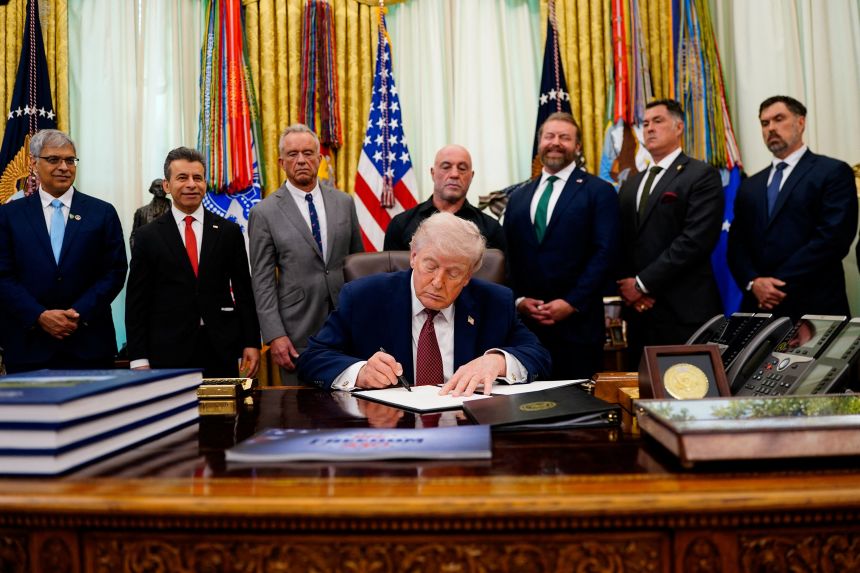
On April 18th, the day before Bicycle Day, President Trump signed an executive order directing federal agencies to accelerate research and expand access to psychedelic compounds as potential treatments for serious mental illness. Six days later, the FDA moved quickly on the order’s directives — issuing priority vouchers to three companies studying psilocybin and methylone, and opening the door to the first-ever human trials of ibogaine derivatives in the United States.
For a field that spent decades operating on the margins of mainstream medicine, it was a notable week.
We’ve been following this space closely for a long time. Here’s what the order actually does, what it doesn’t, and why we think it matters.
What the Executive Order Does
The order moves on several fronts simultaneously. It directs the FDA to issue Commissioner’s National Priority Vouchers to psychedelic compounds that have already received Breakthrough Therapy designation — a status the FDA grants when early clinical evidence suggests a drug may offer substantial improvement over existing treatments. Those vouchers compress the standard FDA review timeline from six to ten months down to as little as one to two months.
Two of the three companies that received vouchers this week are studying psilocybin — one for treatment-resistant depression, one for major depressive disorder. A third received a voucher for methylone, a compound being studied for PTSD. It’s the first time the FDA has offered this kind of fast-tracking to any psychedelic compound.
Beyond the vouchers, the order commits $50 million through ARPA-H — the federal Advanced Research Projects Agency for Health — to match state-level investments in psychedelic research programs. It directs the FDA, HHS, and the Department of Veterans Affairs to collaborate on expanding clinical trial participation. And it instructs the DEA to initiate rescheduling reviews for compounds that successfully complete Phase 3 clinical trials, meaning the path from clinical approval to legal reclassification is now formally mapped.
What It Doesn’t Do
This is worth being clear about, because the headlines can run ahead of the reality.
Psilocybin is still a Schedule I substance. These compounds are not on track for pharmacy shelves. The FDA was explicit that the priority vouchers don’t indicate safety or efficacy — only that qualified drugs will be reviewed faster once the clinical data is complete. If any of these compounds do receive FDA approval, they’ll be administered in supervised clinical settings under medical guidance, not independently.
The order is also primarily focused on ibogaine — a psychoactive compound derived from a West African shrub that has drawn attention for its potential in treating opioid addiction and PTSD, particularly among veterans. Psilocybin benefits significantly from the order’s structures, but it wasn’t the named focus. That distinction matters for understanding where the policy momentum is concentrated.
Why Psilocybin Is in This Conversation at All
The research that earned psilocybin its Breakthrough Therapy designations wasn’t built overnight. It’s the product of more than a decade of rigorous clinical work — primarily out of Johns Hopkins University and Imperial College London — that slowly, carefully accumulated evidence that psilocybin could do something conventional treatments often cannot: produce sustained reductions in depression symptoms, sometimes after a single guided session, in patients who had already tried and exhausted other options.
That body of work is what put psilocybin in the FDA’s Breakthrough Therapy category in the first place. The executive order didn’t create the scientific case — it responded to one that had already been built.
What We Think This Means
Wild Mind exists in a specific lane. We’re not a clinical brand, and our products aren’t treatments. But we’ve always believed that the more clearly people understand this territory — the history, the science, the genuine potential alongside the honest limitations — the better positioned they are to engage with it thoughtfully.
What this week signals, more than any specific policy outcome, is a shift in what’s considered worth taking seriously. The question of whether psychedelic compounds deserve urgent, well-funded, federally supported scientific inquiry has been answered. That’s not nothing.
For a community that has spent years operating in the space between underground and overlooked, there’s something meaningful about watching the conversation move — not because federal validation is the only kind that matters, but because it tends to open doors that were previously closed. More research means more understanding. More understanding means more informed people. That’s a direction worth paying attention to.
We’ll keep following it, and we’ll keep sharing what we learn.